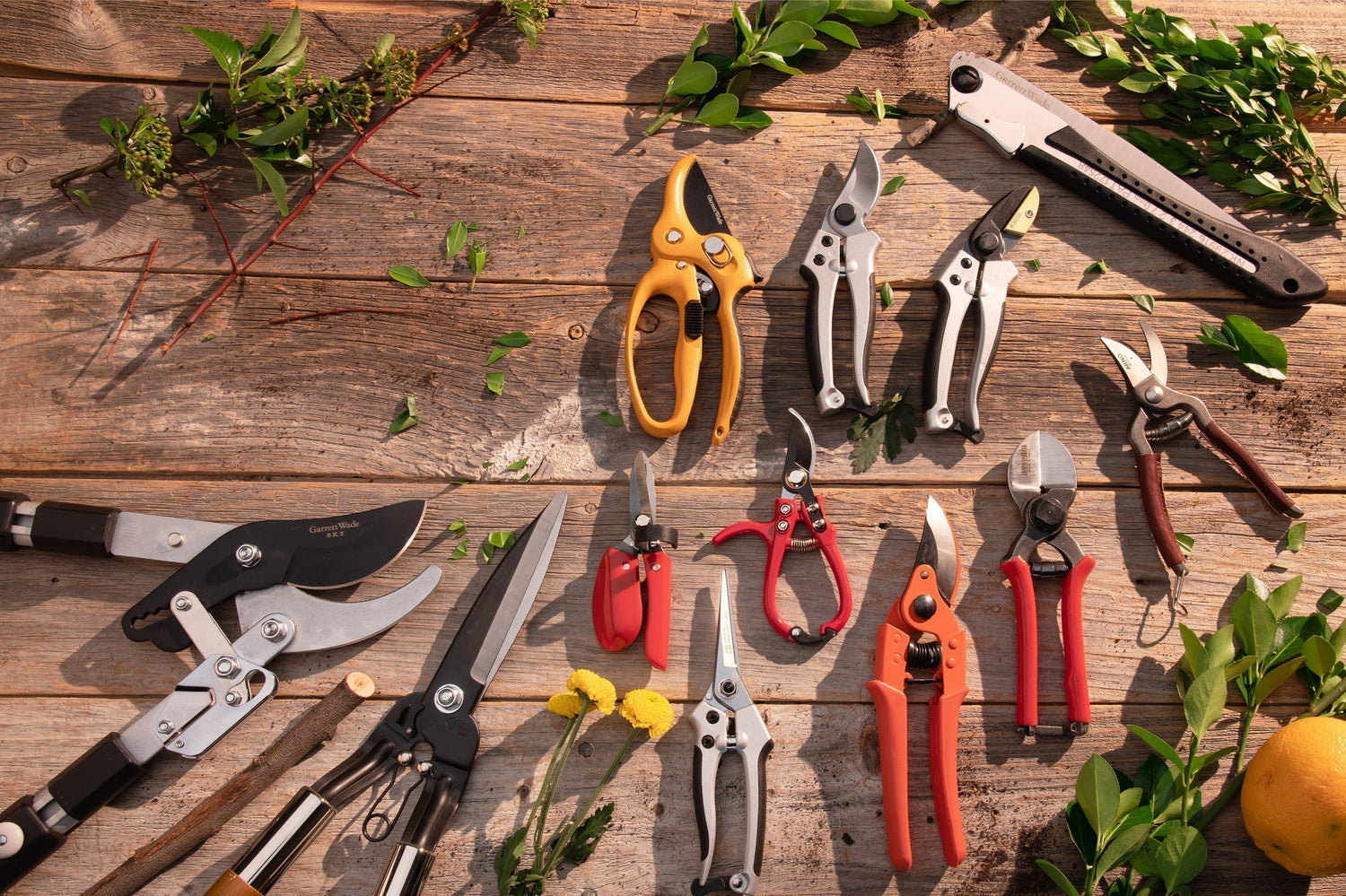
A good pruner is one of the most essential tools you can own as a gardener. But knowing which tool to reach for (and how to use it) makes all the difference between a plant that thrives and one that struggles. This list of tips and techniques walks you through commonplace pruning techniques, when to use them, and which tools from our collection are best suited to each task. Browse our full selection of pruning tools here.
When to Prune
First thing's first: timing matters enormously. Late winter and very early spring (before new growth begins) is the ideal window for most trees, shrubs, and roses. Without leafy foliage present, you can clearly see the branch structure, spot damage from winter weather, and make clean cuts before the growing season kicks off. Summer pruning is useful for controlling continued growth or for shaping more ornamental plants, but you should avoid heavy cutting in late summer or fall, as this can stimulate tender new growth that won't harden off before frost sets in.
Flowering shrubs follow their own calendar. Spring-blooming plants like lilacs and forsythia set their flower buds on last year's wood, so prune them right after they've bloomed, rather than in fall or early spring (or you run the risk of cutting off next year's flowers). Summer-blooming shrubs like butterfly bush and rose of Sharon bloom on new wood, and can be cut back hard during early spring.
Make Cuts Clean and Correct
No matter which technique or tool you're using, you should be trying to make every cut as clean and precise as possible. Ragged, crushed, or torn cuts invite disease and slow healing. This is another reason why tool quality is so important: a sharp, well-maintained blade does far less damage to plant tissue than a dull one. Always cut just above a bud or lateral branch, angling the cut slightly away from the bud so water sheds away from it. Avoid cutting too close to the bud or its collar. Leaving too long a stub can die back and become an entry point for disease.
A good practice (especially when dealing with diseased material) is to wipe down the blades of your pruner with a diluted bleach solution or rubbing alcohol to avoid spreading pathogens from one plant to another.
Knowing Your Cuts
Thinning Cuts

Thinning removes entire branches back to their point of origin. Essentially, you're cutting a piece of growth back to its main trunk, or to a larger lateral branch. This opens up the canopy, improves air circulation, and lets light reach the interior of the plant without changing its overall size or shape. You should be cutting directly above the branch's collar (the enlarged bit where the growth splits off), rather than into the collar itself, as this can disrupt the plant's natural healing. Thinning is the gentlest and most natural-looking approach to pruning, and it's the preferred method for trees and large shrubs where you want to preserve the plant's natural form.
For thinning branches up to about an inch in diameter, a quality hand pruner is your tool. Our Forged Carbon Steel Hand Pruners are an excellent everyday choice. They feature thick forged-steel blades with a 1¼" maximum cutting capacity, and are hard to beat in terms of their versatility and simplicity.
For branches between 1" and 2" in diameter, step it up to loppers. Our Extendable Ratcheting Pruning Loppers are built exclusively for Garrett Wade and have earned rave reviews for over a decade. Their telescoping handles extend from 26" to 40", giving you the adjustable leverage to thin branches deep inside a tree or shrub without a ladder. The oversized ratcheting mechanism slices through those medium-sized branches with minimal effort, and will prove genuinely useful when you're working through larger growth.
Heading Back (or Heading Cuts)

A heading cut removes only part of a branch — cutting back to a bud, a side shoot, or a set length. Unlike thinning, heading cuts stimulate vigorous new growth below the cut, which is exactly what you want when you're trying to encourage bushiness, rejuvenate an older plant, or shape a hedge. Roses, fruit trees, and most flowering perennials respond very well to heading back.
For this kind of precise, directional cutting, where you're choosing exactly which bud to cut above, the bypass style is the right choice. Bypass blades work like scissors: one sharp blade passes alongside a thicker counter-blade, making a clean, close cut with minimal crushing of plant tissue. This is particularly important on live, green wood. Our imported Ergonomic Italian Pruners are a great example of this, with a strong bypass blade and nicely shaped rubber-coated handles, they are beautifully made and very comfortable in use.
One thing worth noting: a longer handle provides more leverage (torque) on the blades, which can be useful when cutting thicker stems. But for fine heading work on roses or perennials, a compact pruner can give you better control and precision. Our spring-loaded Small Bypass Pruners are designed for precision, easy to carry, and have supremely ergonomic handles for delicate cuts.
Cutting Deadwood
Deadwood (dead, dry, or diseased branches) needs to come out cleanly and efficiently. This is where an anvil-style pruner has a real advantage. Rather than the scissor action of a bypass, an anvil pruner cuts by pressing a single sharp blade down against a flat metal plate (the anvil). The resulting action crushes slightly — which doesn't matter on dead wood — and delivers significantly more cutting power for the same amount of hand pressure.
Our Cast-Aluminum Anvil Pruner is purpose-built for this job, featuring a sturdy, sharp blade, a spring-loaded catch, and a comfortable 8" overall length. Both the anvil pruner and its bypass blade counterpart are available as part of our Cast-Aluminum Pruner Set. If you tend to have a mix of live-growth work and deadwood removal in your garden, owning both the bypass and anvil styles means you'll always have the right tool at hand.
For larger deadwood — say, branches that a hand pruner can't handle but a full lopper or sawblade feels like overkill — our Heavy-Duty Anvil Lopper fills the gap nicely. With a cutting jaw capacity of 2 to 2½ inches and telescoping handles, it powers through dry, tough material that would otherwise strain a bypass lopper.
Use Ratcheting Tools When You Need Extra Power

Even experienced gardeners run into branches that resist a clean cut — wood that's denser than expected, or a day when your hands are tired after hours of work. A ratcheting pruner gives you a mechanical advantage by letting you take multiple partial squeezes to complete a single cut, with the ratchet holding the blade position between each compression.
Our Ratcheting Hand Pruner is a longtime favorite. It's all cast aluminum with a rubber grip, carbon steel blade with non-stick coating (replaceable via a bolt on the side), and an enclosed scissor-style finger loop for added protection. There's also a small oil pad built into the handle so you can clean and lube on the go. Maximum opening is 7/8". It works exactly like a normal pruner — until you need that extra gear. When you hit resistance, simply relax your grip, the ratchet resets with the jaws in place, and you squeeze again. It can tackle branches that would be too thick for a conventional pruner of the same size.
For ratcheting power scaled up to lopper size, we once again recommend our Extendable Ratcheting Pruning Loppers. We might push this pair of tools often, but we are confident they will easily be some of the best pruning implements you've ever used.
Use Pruning Saws for Larger Limbs
When a branch is too large for loppers — generally anything over 2" — it's time for a pruning saw. Unlike loppers, which compress the wood as they cut, a saw removes material cleanly and is far less likely to cause bark tearing on exceptionally large branches. When using a saw, always undercut slightly before the final cut to prevent the branch weight from tearing bark down the trunk.
For most garden pruning saw work, a folding saw can be a practical and convenient carry. Our Japanese-Style Folding Pruning Saw has a full 10" long blade with a 3/16" tooth depth. The Japanese tooth pattern cuts on the pull stroke, which means less effort and a cleaner cut than a traditional push-cut saw. It folds to pocket size, making it easy to carry into a tree or along a hedgerow.
For more robust greenwood, our Arborist Large Raker-Tooth Pruning Saw is a full size implement that can be especially useful when cutting larger branches. The ergonomic handle has a cushioned insert that makes the saw very controllable for long periods, and it's surprisingly lightweight for its size at a well-balanced 16oz. It is an excellent complement to the standard non-raker pruning saw, at a very affordable price. It also comes as part of our bestselling High-Capacity Pruning Set, which is extremely handy for long-reach jobs.
Shearing for Hedges and Formal Shapes

Shearing (making many small cuts along a flat plane) is how you maintain formal hedges, topiary, and tightly clipped shapes. It's often what you see professional gardeners doing when they're maintaining decorative plants. It's a different motion and a different tool from the precision cuts described above. Garden shears (also called hedge shears) have long blades designed to take sweeping cuts across a surface, rather than the precise point-cutting of a hand pruner. One of our favorites in this category is our own supremely durable Super-Tough Hedge Shear.
For tall hedges or overhead work, our Long-Reach Pruning Tools give you the reach to work from the ground without overextending or climbing.
Choosing Handle Style and Size
Handle size is a personal choice, but it matters more than most people think. If you have smaller hands, a compact pruner will feel more natural and reduce fatigue. Average and larger hands work well with standard-sized tools. People with large hands should specifically avoid the smaller models, they'll require more grip pressure (which defeats the purpose). One consistent principle: a longer handle delivers more leverage to the blades, which is useful for thicker material but less important for fine precision work.
Caring for Your Pruners
A sharp pruner is a safe pruner and a kind one — to you and to your plants. Wipe blades clean after each use, oil the pivot point occasionally, and sharpen the cutting blade when you notice it tearing rather than slicing. Our ratcheting pruner makes this easy with its built-in oil pad; for other models, a drop of camellia oil or similar light oil on a cloth takes thirty seconds and extends blade life considerably. Store pruners dry and closed to protect the blade edge.
Choose Quality Tools

Garrett Wade offers a variety of high-quality pruners to suit different needs regarding handle styles, blade configurations, and origin. If you're looking for a personal recommendation, start with a quality bypass pruner as your everyday tool. Our Ultra-Sharp Pruner and Sheath Sets are some of our most popular options for portable, everyday carry, and come in a range of colors for a personal touch.
If you're looking for a pruner that really pulls out all the stops, take a look at our French-Made Trim Pruner & Holster Set. With supremely smooth operation, leather-wrapped handles, and an accompanying leather sheath, they'll quickly become one of the most prized possessions in your garden shed.
If you're building out a kit from scratch, the Everyday Complete Pruning Set is a smart starting point. It includes three hand pruners (bypass, anvil, and flower cutter), forged-steel bypass loppers, and a Japanese-tooth folding saw — everything needed to handle pruning tasks from deadheading flowers to tackling small trees, all in one well-considered set.
With the right tools and techniques, pruning becomes one of the most rewarding tasks in the garden. Happy pruning!
✂️